A detailed case study in the journal Rhodora, authored by 4 Harvard Forest colleagues and a Summer Research Program alumnus, explores 250 years of land-use history in the Simes Tract of Petersham, where scientists began the long-term Hemlock Removal Experiment in 2005.
Historical documents, stand mapping, and new methods of dendrochronological analysis show that most of the hemlocks in the Simes tract are less than 150 years old. In contrast, other well-studied hemlock forests in our region established more slowly, in the shade of continuously forested colonial woodlots.
The study details the forest’s history as the Chamberlain/Towne and Gleason Farms, which were cleared for houses, barns, livestock fences, cart roads, orchards, and a cider mill in the late 18th century. Analysis of the tree ring record shows that the Simes tract hemlocks grew to dominance in the 1920s after 3 major human and natural disturbances: the loss of American chestnut to the chestnut blight, a period of selective logging, and a 7-year
- Read the full paper by Ellison et al. in Rhodora: “Building a foundation: land-use history and dendrochronology reveal temporal dynamics of a Tsuga canadensis (Pinaceae) forest”
- Learn more about hemlock studies at the Harvard Forest
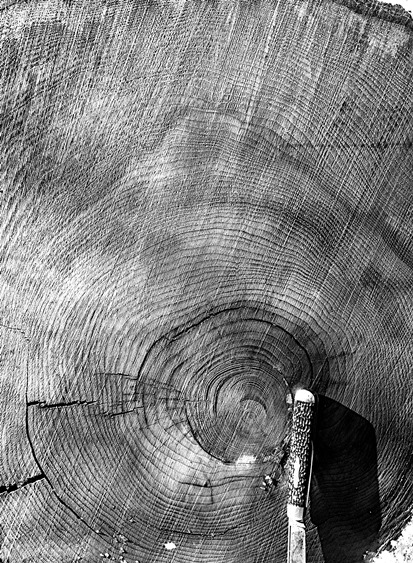
(Photo of a hemlock cross-section studied by Bob Marshall, from the Harvard Forest Archive.)