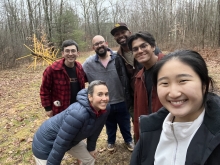
Harvard Forest Wintersession Internships bring Harvard students (undergraduate and/or graduate) to the Forest in January for paid, on-site research internships. Interns will work directly with mentors on projects related to Indigenous representation, forest ecology, environmental education, and more (described below). In addition to a paid stipend, room, board, and transportation will be provided to interns at no cost.
Read highlights about the work of our January 2025 interns, January 2024 interns, January 2023 interns, and January 2022 interns.
2027 Wintersession Internships will run from January 6-22, 2027.
To apply, see required application materials at the bottom of each project description. All applications are due through the Crimson Careers portal or directly to <bgoulet@g.harvard.edu> by the end of the day on November 5, 2026.
Project 1: Amplifying Indigenous Voices in the Fisher Museum
(open to Harvard undergraduates and graduate students, in-person)
Mentored by Nia Holley, Nipmuc Community Mentor; Tyler White, Harvard Graduate School of Design ’26; and Clarisse Hart, Harvard Forest Director of Education and Outreach
A small federal grant has enabled an important update to the Fisher Museum of forest history, with new content and interpretation to explore the ways Indigenous stewardship legacies have defined today’s landscape and bring resilience to the land of tomorrow. The two students selected for this internship will work with mentorship by the exhibit co-curators (Nia Holley, Nipmuc artist and community organizer, and Tyler White, experienced designer and recent Harvard GSD grad) and Fisher Museum education staff to 1) develop a community review/talk-back process for the current draft elements of the exhibit (video, audio, and written materials), and 2) compile content, including archival media, to populate public outreach and educational materials to accompany the exhibit’s launch in summer 2027.
Successful candidates will possess a combination of the following skills/experiences:
- Excellent written and verbal communication skills that can be applied to relating to constituents with a diversity of backgrounds, needs, and goals
- Experience amplifying the voices of Indigenous communities
- Experience interacting with art objects and/or archival primary sources
- Experience in evaluation: community focus groups, surveys
- Familiarity with visual design media (InDesign, Illustrator, Photoshop)
- Creativity! Ability to edit audio/video a plus
To apply, please submit a combined PDF file to <bgoulet@g.harvard.edu> by the end of the day on Thursday, Nov. 5 that includes:
- A resume that includes your contact info, study concentration, and graduation year, plus a list of 3-5 relevant courses you have taken, and 3-5 relevant jobs or activities you have had
- Contact info for two academic or professional references
- A 250-500-word statement of interest exploring these questions:
- What would be some of the key elements of your personal approach to relational work with our local Indigenous community, the Nipmuc People?
- How can amplification of Indigenous voices be generative within the current structures of Harvard academia and museums?
Project 2: Forest Landscape Ecology – Spatial Data Analyst
(open to Harvard undergraduates and graduate students, in-person)
Mentored by Jonathan Thompson, Harvard Forest Senior Ecologist; and Danelle Laflower, Harvard Forest Research Assistant
The Thompson Lab at Harvard Forest is looking for a graduate or undergraduate intern to join our research group this winter and spring. The internship starts with a residential “Wintern” at Harvard Forest in Petersham, MA over J-term. During that time the intern will live and work at the Forest, get to know the lab and the landscape, and lay the groundwork for an independent project. Through the spring semester, the intern will keep working on the project, mostly remotely, with regular meetings with lab members. The research will focus on temperate forest landscape ecology and build on the lab’s ongoing work on long-term forest change and the effects of land-use decisions on forest ecosystems and forest carbon. We’ll shape the specific project around the student’s skills and interests. Preference will be given to applicants with experience using R for data manipulation and spatial data analysis.
Successful candidates will possess a combination of the following skills/experiences:
- Interest in forest ecology, ecological data analysis, and data visualization
- Experience with R statistical software, spatial data analysis, and GIS is strongly preferred
- Strong communication skills and ability to work independently
To apply, please submit a combined PDF file to <bgoulet@g.harvard.edu> by the end of the day on Thursday, Nov. 5 that includes:
- A resume that includes your contact info, study concentration, and graduation year, plus a list of 3-5 relevant courses you have taken, and 3-5 relevant jobs or activities you have had
- Contact info for two academic or professional references
- A 250-500-word statement of interest exploring these questions:
- Why do you think this internship would be valuable for your academic career?
- What about your background would make you a good fit for this position?
Project 3: History of the Bob Marshall Trail
(open to Harvard undergraduates and graduate students, in-person)
Mentored by Emery Boose, Harvard Forest Information Manager and Senior Scientist; and Julie Hall, Harvard Forest Assistant Information Manager
The Bob Marshall Trail is a primitive trail for hiking and snowshoeing that connects the Prospect Hill and Tom Swamp tracts of the Harvard Forest. Named after Bob Marshall (founder of the Wilderness Society and a student at the Forest in 1924) and recently completed (in fall 2026), the trail remains largely unexplored in terms of its educational potential for visiting classes and groups. We seek an intern who would enjoy investigating the history of property use and ownership, logging operations, and conservation restrictions along the trail; as well as archival records of photographs, maps, surveys, and other related materials. The project will be largely indoors, working with materials in the Harvard Forest Archives and researching questions online (e.g., at the Mass Registry of Deeds), but there will also be opportunities to experience the trail in winter and become familiar with stone walls and other landmarks from early settlement days, as well as present-day signs of moose, deer, and other wildlife. Curiosities include artifacts from the Civilian Conservation Corps (1930s) and a buried communications cable from the Cold War (1960s). For more information on the trail, please see: https://townofpetersham.gov/open-space/bob-marshall-trail/.
Successful candidates will possess a combination of the following skills/experiences:
- Interest in history, land use, and forest ecology
- Willingness to do winter fieldwork (Harvard Forest can help provide winter gear for safety and comfort)
To apply, please submit a combined PDF file to <bgoulet@g.harvard.edu> by the end of the day on Thursday, Nov. 5 that includes:
- A resume that includes your contact info, study concentration, and graduation year, plus a list of 3-5 relevant courses you have taken, and 3-5 relevant jobs or activities you have had
- Contact info for two academic or professional references
- A 250-500-word statement of interest exploring these questions:
- What interests you about this project?
- What in your background makes you a good fit for this internship?
Project 4: Changing Environmental Controls on Forest-Atmosphere Interactions
(open to Harvard undergraduates and graduate students, in-person)
Mentored by Matteo Detto, Harvard Forest Senior Scientist
Forest ecosystems respond dynamically to changes in climate and environmental conditions, but whether these responses remain constant over decades is poorly understood. The Harvard Forest eddy-covariance tower provides a unique record of ecosystem carbon exchange and environmental conditions spanning more than three decades, beginning in the early 1990s. We are seeking an intern to investigate whether the environmental controls on forest carbon uptake have changed over this period. The intern will use long-term flux-tower and meteorological data to develop machine-learning models relating carbon, water, and energy fluxes to environmental drivers such as radiation, temperature, vapor pressure deficit, and soil moisture. The project will involve data processing, statistical analysis, machine-learning modeling, and visualization, primarily using R, Python, or MATLAB. The intern will gain experience working with long-term ecosystem observations and modern data-analysis approaches while contributing to a broader effort to understand how forest responses to climate and environmental variability change over time. During the internship, there will also be an opportunity to visit the flux tower and learn about biogeochemical and environmental monitoring. There is an opportunity to stay involved with the project beyond the Winternship and contribute to a peer-reviewed publication.
Successful candidates will possess a combination of the following skills/experiences:
- Interest in forest ecology, ecosystem carbon cycling, and climate–ecosystem interactions
- Experience with data analysis, programming, and visualization (or willingness to learn)
- Interest in learning machine-learning methods; prior experience with machine learning is helpful but not required
To apply, please submit a combined PDF file to <bgoulet@g.harvard.edu> by the end of the day on Thursday, Nov. 5 that includes:
- A resume that includes your contact info, study concentration, and graduation year, plus a list of 3-5 relevant courses you have taken, and 3-5 relevant jobs or activities you have had
- Contact info for two academic or professional references
- A 250-500-word statement of interest exploring these questions:
- Why are you interested in studying how forests respond to environmental change over long timescales?
- What experience do you have with ecological data analysis, programming, or quantitative methods that would prepare you for this project?
Project 5: Research on Citizen Science in K12 Education
(open to Harvard undergraduates and graduate students, in-person)
Mentored by Katharine Hinkle, Harvard Forest Manager of Youth Education
The Harvard Forest Schoolyard Ecology Program has been running for over 22 years, connecting the research at Harvard Forest to K12 classrooms and providing opportunities for students to practice authentic science practices. Schoolyard Ecology is working with the FieldScope project to expand the audience for our projects. We are seeking an intern interested in citizen/participatory science, science communication, and environmental education. The intern will learn about database development and will help develop content about schoolyard ecology for the FieldScope website.
Successful candidates will possess a combination of the following skills/experiences:
- Interest in education research
- Experience working with spreadsheets
To apply, please submit a combined PDF file to <bgoulet@g.harvard.edu> by the end of the day on Thursday, Nov. 5 that includes:
- A resume that includes your contact info, study concentration, and graduation year, plus a list of 3-5 relevant courses you have taken, and 3-5 relevant jobs or activities you have had
- Contact info for two academic or professional references
- A 250-500-word statement of interest exploring these questions:
- Why do you think that this internship would be a valuable opportunity for your growth as a researcher?
- What do you hope to learn/gain from this experience?
Logistics for All Internship Projects
- Program dates: Wednesday, January 6, 2027 through Friday, January 22, 2027, with MLK Day off (84 total hours of work)
- Interns will be paid a one-time stipend of $1920 (undergraduates) or $2112 (graduate students) at the conclusion of the internship.
- Interns will live on site at Harvard Forest in Petersham, MA and work full-time (35 hrs/wk).
- Room and board are provided at no cost to the intern. Interns are housed in a small farmhouse dorm on the Harvard Forest campus, with students in single or shared bedrooms and shared common areas.
- Interns will cook their own meals in the dorm kitchen and be driven to the local Market Basket grocery store weekly to obtain groceries (funded by Harvard Forest) for those meals.
- Transportation between Harvard Square and Harvard Forest at the beginning and end of the program is provided cost-free as part of the internship. Students who have their own cars are welcome to bring them (we will reimburse your mileage between Harvard Square and Harvard Forest at the beginning and end of the program).
- Harvard Forest is located in a remote area (Petersham, Massachusetts is a rural town of 1,000 people), 70 miles west of the main Harvard campus. Public transportation is not available here. Interns’ work and free time will be spent here on the quiet Harvard Forest campus, unless they have their own car.
- Harvard University wifi is available throughout campus, including the dorm.
- Interns are given their own desk in a shared office workspace in the main HF building and all necessary supplies.
- Interns can expect daily or near-daily check-ins with their project mentors – but there also will be a strong expectation for independence and self-motivation in the work. The full intern cohort will be offered a weekly guided field trip to explore the local landscape. For your free time, there are many hiking trails at Harvard Forest and we will provide snowshoes for those who would like to use them.
- Harvard Forest has a Code of Conduct that everyone working and living here is expected to follow.
- Harvard Forest is a department of Harvard University, so all relevant university policies, including COVID protocols, are in place here.
The Harvard Forest welcomes individuals with disabilities to participate in its programs. If you anticipate needing any type of accommodation for the application process or have questions about the physical access and resources provided on-site, please contact us at hfvisit@fas.harvard.edu.