73oF, 23oC at 8:45am
Prospect Hill Canopy Webcam
|
Research and Education in Ecology, Conservation
and Forest Biology
Since 1907 research and education have been the mission of the Harvard Forest, one of the
oldest and most intensively studied forests in North America. From a center
comprised of 3000 acres of land, research facilities, and the Fisher Museum
the scientists, students, and collaborators at the Forest explore
topics ranging from conservation and environmental change to land-use
history and the ways in which physical, biological and human systems interact
to change our earth.
July Highlights
Harvard Forest Schoolyard Program Featured in the News
HF Ecologist,David Orwig's work with the Schoolyard Ecology project "Hemlock Trees and the Pesky Pest, the Woolly Adelgid" was featured on the front page of the Greenfield Recorder recently. See the article about Greenfield High School students and teacher Christine Perham's experience in doing ecological field research in Greenfield.
Harvard Forest Receives Safe Drinking Water Award
Harvard Forest recently was awarded the Massachusetts Public Drinking Water Award, which recognizes public water systems for outstanding performance. In a ceremony at the State House, MassDEP Commissioner Laurie Burt presented the award to Michael Scott, Edythe Ellin, and Ronald May. Winning systems were determined based on their compliance with state drinking water regulations. The 32 award winners (out of 1,736 systems state-wide) had no monitoring enforcements or violations, submitted all required reports on time, adhered to good water management procedures and have excellent source protection standards.
New Publications
New Book Examines the History of Agriculture, Ecological Change and Conservation across the U.S.
 The introduction, spread, and abandonment of agriculture represents the most pervasive alteration of the earth's environment in recorded history. This new volume edited by Charles Redman from Arizona State University and David Foster from Harvard Forest, draws on research at six U.S. Long-Term Ecological Research sites, to describe what happens when humans alter natural ecological regimes through agricultural practices. Although each research site has its own unique agricultural history, patterns emerge that help us understand the impact of our actions on the earth, and how the earth pushes back.
"The synthesis that emerges is a powerful example of the insights that come from interdisciplinary networks of scientists who share a long-term view. This is a compelling example of the value of long-term research in which scientists from disparate backgrounds come to brilliant insights through intellectual networks that develop over many years of shared work."
-STEPHEN R. CARPENTER, Stephen Alfred Forbes Professor, Center for Limnology, University of Wisconsin-Madison
Learn more and/or purchase the book.
Invasive Plant Studies
 Previous work at the Harvard Forest has shown that mycorrhizal fungi of herbaceous plants are inhibited by the invasion of garlic mustard. In this paper, researchers at the Harvard Forest, the Department of Organismic and Evolutionary Biology at Harvard University, and at Boston University demonstrate that ectomycorrhizal fungal communities in conifer dominated forests are also inhibited by the invasion of garlic mustard in multiple forest types throughout New England. The decline of ectomycorrhizal fungi due to garlic mustard invasion may have implications for tree seedling establishment and biogeochemical cycling in forest soils.
Wolfe, B.E., V.L. Rodgers, K.A. Stinson and A. Pringle. 2008. The invasive plant Alliaria petiolata (garlic mustard) inhibits ectomycorrhizal fungi in its introduced range. Journal of Ecology 96: 777-783.
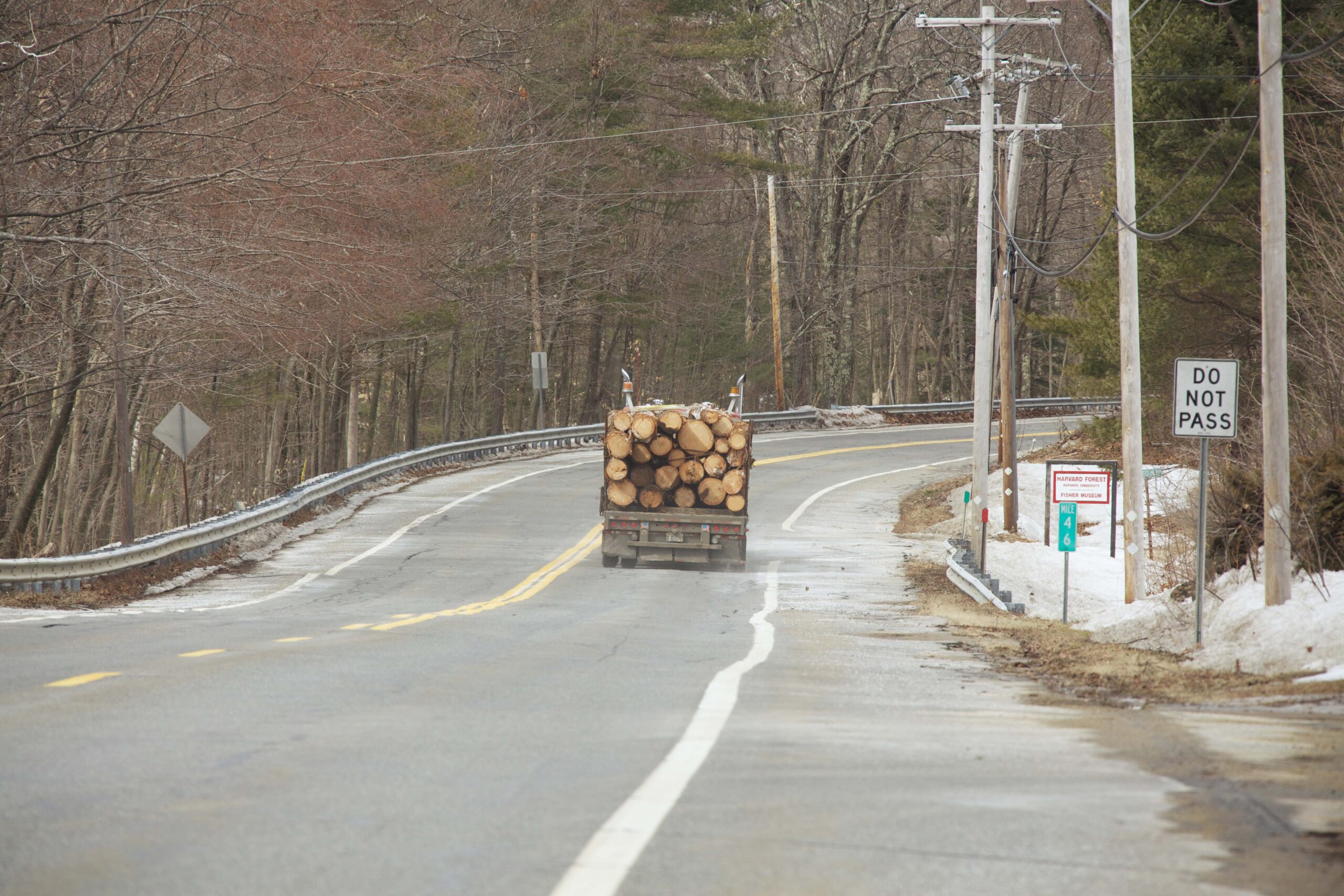
The Effect of Logging in Western Massachusetts
Forest harvesting is one of the most significant disturbances affecting
forest plant composition and structure in eastern North American forests,
yet few studies have quantified the landscape-scale effects of widespread,
low-intensity harvests by non-industrial private forest owners. Using
spatially explicit data on all harvests over the last 20 years, we sampled
the vegetation at 126 sites throughout central and western Massachusetts,
one-third of which had not been harvested, and two-thirds of which had
been harvested once since 1984. Seedling and sapling densities increased
with increasing harvest intensity, but decreased to levels similar to
unharvested sites by year 20 for all but the most intensive harvests. The
composition of understory trees appears to be only slightly changed by
harvesting, and was strongly correlated with adult tree composition.
Overall, the compositional impacts of harvesting were minor, perhaps
because of the low-intensity of harvesting. However, our results support
observations from elsewhere in the northeastern U.S. of limited oak
regeneration on both harvested and unharvested sites. In addition, our
results suggest that increased harvest intensity may be expected to alter
forest composition, particularly on rich sites where invasive species may
increase as a result of harvesting.
McDonald, R.I., G. Motzkin, D.R. Foster. 2008. The effect of logging on vegetation composition in Western Massachusetts. Forest Ecology and Management 255: 4021–4031.
|